Home
- LEDsaddremove
- Componentsaddremove
- Power suppliesaddremove
- LED strips
- LED modules
- Aluminum profiles and accessoriesaddremove
- LED, CCFL rings
- Lampsaddremove
- Car bulbsaddremove
- Accessoriesaddremove
- Smart homeaddremove
- Shielding technologyaddremove
- Metal fireplaces




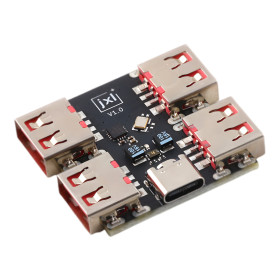
USB-C charging module for Li-Pol and 18650 batteries
This compact charging module is designed for single-series 3.7V lithium batteries (fully charged 4.2V), such as 18650 or polymer cells. It offers reliable and safe charging with protection against overcharge, overcurrent and underdischarge. Thanks to the USB Type-C connector and high-quality chip, it is an ideal choice for projects powered by Li-Ion batteries.
Technical specifications
- Input: USB Type-C (5V)
- Designed for: 3.7V Li-Ion/Li-Pol batteries (fully charged 4.2V)
- Charging current: default 1A
- Protections: overcharge, undercharge (2.4V), overcurrent (4A), short circuit, overheating
- Precharge: 100 mA
- Input voltage range: 4.5–6.5V (resistance up to 9V)
- Charging indication: red LED (charging), blue LED (fully charged)
- Operating temperature: -40°C to +80°C
- Dimensions: 16.8 × 12 mm, mounting hole spacing 10 mm, internal 5.2 mm
Functions and features
- Programmable linear charging current
- Constant current / constant voltage
- Soft start – inrush current limitation
- Battery reverse connection protection
- Low standby power consumption – extends battery life
- Dual status indication output (charging, no battery, error)
Ideal for
- Charging Li-Ion and Li-Pol cells (e.g. 18650)
- Battery-powered electronics projects
- DIY power banks and small portable sources
- Educational and hobby projects with microcontrollers
Package contents
- 1× 3.7V charging module with USB Type-C input
Why choose this product?
- Compact and simple module with high reliability
- Integrated protections for safe charging and operation
- Easy integration into projects thanks to Type-C connector
- Possibility to adjust the charging current according to the battery capacity
- Visual indication of charging and battery status via LED

- Input voltage
- 4,5-6,5 V DC
- Output voltage
- 4.2 V DC
- Output current
- 1 A
This module is designed for charging single-series 3.7V lithium cells (Li-Ion, Li-Pol). It is equipped with protection against overcharge, over-discharge, overcurrent, and short circuit. Thanks to the USB Type-C input and compact dimensions, it is suitable for a wide range of DIY and professional applications.
1. Description and principle of operation
- The module works on the principle of linear charging with constant current followed by constant voltage.
- After reaching the final charging voltage of 4.2V, the charging current gradually decreases.
- When the current drops below 100 mA, the charging cycle automatically ends.
- If the battery voltage drops below 4.05V again, the module restarts charging.
2. Electrical connection
- Power input: via USB Type-C (recommended source 5V/1A or higher).
- B+ – connect to the positive pole of the battery.
- B- – connect to the negative pole of the battery.
- OUT+ and OUT- – outputs protected against undervoltage and overload (e.g., for powering a microcontroller, LEDs, etc.).
3. Operation indication (LED)
- Red LED (CHRG) on – charging in progress.
- Blue LED (STDBY) on – battery fully charged.
- No LED on – no battery connected or an error occurred.
- Red LED blinking – problem with temperature, low cell voltage, or poor contact.
4. Charging current setting
The default charging current is 1A (resistor approx. 1.2 kΩ). If another current is needed, resistor RPROG must be replaced. This resistor is of type SMD 0603 and must be desoldered and replaced with another one. Without replacement, the current remains fixed at 1A.
Recommended values table:
- 30 kΩ → approx. 50 mA
- 5 kΩ → approx. 250 mA
- 2 kΩ → approx. 580 mA
- 1.2 kΩ → approx. 1000 mA (default value)
The recommended charging current is approx. 0.3–0.5C of the cell capacity (e.g., 400–500 mA for a 1000 mAh battery).
5. Safety precautions
- Do not connect the battery in reverse – risk of damage to the module and the battery.
- Do not use with cells below 2.4V (undervoltage protection).
- Batteries must not be connected in series, only in parallel.
- Ensure good wire contact – high resistance may cause voltage drops.
- Chip heating during charging is normal, ensure ventilation.
- For the first activation of protection, connect the module to the power supply before connecting the load.
6. Usage recommendations
- Ideal charging current = 0.37C (e.g., 370 mA for a 1000 mAh battery).
- For long battery life, it is recommended not to discharge below 3.0V.
- If it is necessary to power the device directly from the outputs, it is recommended to protect the battery with a fuse.
- For applications with higher current draw, batteries can be connected in parallel, increasing both capacity and available current.
7. Technical parameters
- Input voltage: 4.5–6.5V (resistant up to 9V)
- Output voltage (battery): 4.2V ± 1%
- Charging current: adjustable 50–1000 mA
- Precharge: 100 mA
- Protections: overcharge, over-discharge (2.4V), overcurrent (4A), overheating
- Dimensions: 16.8 × 12 mm
- Mounting holes: 10 mm, spacing 5.2 mm
- Operating temperature: -40 °C to +80 °C
8. Practical tips
- When charging multiple cells in parallel, the current is divided between them.
- A laboratory power supply with current limiting can be used to test the function.
- When making a power bank, it is advisable to add a step-up converter to 5V.
- The module can also be used as a protective circuit when discharging the cell into a load.
EU Importer: AMPUL SYSTEM s.r.o., Čsl. armády 641/40, 78701 Šumperk, Czech Republic,