

Home
- LEDsaddremove
- Componentsaddremove
- Power suppliesaddremove
- LED strips
- LED modules
- Aluminum profiles and accessoriesaddremove
- LED, CCFL rings
- Lampsaddremove
- Car bulbsaddremove
- Accessoriesaddremove
- Smart homeaddremove
- Shielding technologyaddremove
- Metal fireplaces

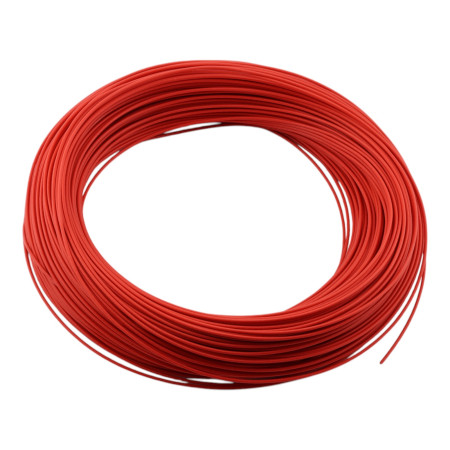


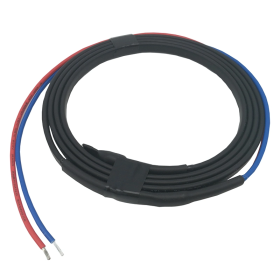
Heating cable ⌀1.4mm, 5-48V DC, Teflon insulation
The 1.4 mm diameter heating cable is designed for low voltage DC applications in the range of 5–48 V DC, where uniform heating, mechanical flexibility and durable insulation are required. It is suitable for integration into heating elements, frost protection, temperature control of smaller areas as well as for construction and service use in technical equipment.
Technical specifications
- Product type: resistance heating cable
- Cable outer diameter: 1.4 mm
- Power supply: 5-48V DC
- Insulation: fluoropolymer, Teflon type
- Heating element material: nickel-chromium and copper
- Available resistance options: 0.3 / 1 / 1.4 / 3 / 4 / 5 / 8 / 10 / 15 / 20 / 25 / 40 Ohm/m
- Insulation temperature resistance: up to 200 °C
- Maximum long-term temperature: up to 250 °C
- Cable type: round
- Sales unit: 1 meter
Functions and features
- Designed to create resistance heating when powered by DC voltage
- Teflon insulation ensures good thermal, chemical and electrical resistance
- Resistance to oils, acids and alkalis
- Insulation with good resistance to aging and electric arc
- Flexible design suitable for integration into smaller devices and assemblies
- Possibility to choose resistance per meter according to the required power and cable length
- The power depends on the supply voltage, the selected length and resistance of the cable
Ideal for
- Seat and steering wheel heating
- Refrigerators, air conditioning and defrosting applications
- Heated insoles, footwear, clothing and textile heating elements
- Electric blankets, pads and smaller heating surfaces
- Pipeline protection against freezing
- Heating of windows and smaller structural units
- Incubators, breeding facilities and selected medical facilities
- Special low-voltage heating applications in instrumentation
Package contents
- 1x heating cable in the selected resistance variant
- The delivery length corresponds to the ordered quantity in meters.
Why choose this product?
- Wide power supply range for low voltage DC applications
- Large selection of resistor variants for designing the required power
- Compact 1.4mm diameter for easy integration
- Durable fluoropolymer insulation for operation in more demanding environments
- Suitable solution for technical, development and service use
Installation and operating instructions
- When designing, it is necessary to correctly select the resistance per meter, cable length and supply voltage.
- Approximate power calculation: P = U × U / (L × R), where U is the voltage, L is the cable length and R is the resistance in Ohm/m
- Install the cable in such a way as to ensure even heat dissipation into the heated material.
- During operation, avoid mechanical damage to the insulation and local overheating.
- For stable and safe operation, we recommend using a suitable power supply and regulation.
Safety notice
- Designed for low voltage DC power supply 5-48 V DC
- Do not connect the cable to the 230 V AC mains voltage.
- Before commissioning, verify the electrical parameters of the entire assembly
- The resulting surface temperature depends on the power, installation method and heat dissipation conditions.
- The product is intended as a component for incorporation into a device or technical unit.

- Voltage
- 5-48 V DC
- Average
- 1.2 - 1.4 mm
- Color
- Red
- Quantity core
- 1
- Minimum bending radius
- 4 cm
Heating Cable Power Calculator
How does the calculator work?
-
Input Values
The user enters three main values:- Source Voltage (V): The voltage supplied to the heating cable.
- Cable Length (m): The total length of the heating cable.
- Cable Resistance (Ω/m): Resistance per unit length (usually in ohms per meter).
-
Calculation of Total Resistance
The calculator first computes the total resistance of the cable using the formula:This means that the longer the cable, the higher the total resistance.
-
Calculation of Current using Ohm's Law
According to Ohm's law, it holds that:Where is the voltage and is the total resistance. Therefore, as the cable length (and thus the resistance) increases, the current flowing through the cable decreases.
-
Calculation of Total Cable Power
The total power delivered to the cable is calculated using the formula:Since the current decreases as the resistance (and thus cable length) increases, the total power also decreases.
-
Calculation of Power per 1 m of Cable
The power per unit length (W/m) is obtained by dividing the total power by the cable length:This value is important because the actual heating of the cable depends on how much energy is released per meter. With a very long cable, even if the voltage is the same, the total power is divided over more meters, resulting in a lower power per meter.
-
Display of Results
The calculator then displays:- Cable Current (A): Calculated using Ohm's law.
- Cable Power (W): The total power delivered to the cable.
- Power per 1 m (W/m): The power distributed per meter of cable.
- Approximate Cable Temperature: Instead of a numerical value, text is displayed – if the temperature is 20 °C or lower, "Ambient Temperature" is shown, and if the temperature is 90 °C or higher, "Too high!" is displayed. The calculated value is based on an ambient temperature of 20 °C.
Why does the cable's power decrease with length?
-
Increase in Total Resistance:
The cable's resistance is specified in ohms per meter. When you extend the cable, the total resistance increases linearly with its length. For example, if the resistance is 0.1 Ω/m and the cable is 10 meters long, the total resistance will be 1 Ω; if the cable is 100 meters, the resistance will be 10 Ω. -
Decrease in Current:
Since the current is given by the formula = , a higher resistance results in a lower current through the cable. Less current means that less energy is delivered to the cable. -
Total Power and Power per 1 m:
The total power of the cable is given by the formula . As the current decreases, the total power also decreases. Furthermore, this power is distributed along the entire length of the cable. Therefore, the longer the cable, the lower the power per meter, which directly affects the heating. With a very long cable, even if the total power is significant, the power per meter may become extremely low, resulting in inefficient heating of the cable.
EU Importer: AMPUL SYSTEM s.r.o., Čsl. armády 641/40, 78701 Šumperk, Czech Republic,